What needed to change
Ad transparency data is useful for competitive research and policy analysis, but it is not convenient to monitor manually or pipe into downstream workflows.
Built a lower-level data infrastructure tool on Apify for monitoring Google Ads Transparency data, useful for scraping, automation, and downstream LLM/data workflows.
Builder
Ad transparency data is useful for competitive research and policy analysis, but it is not convenient to monitor manually or pipe into downstream workflows.
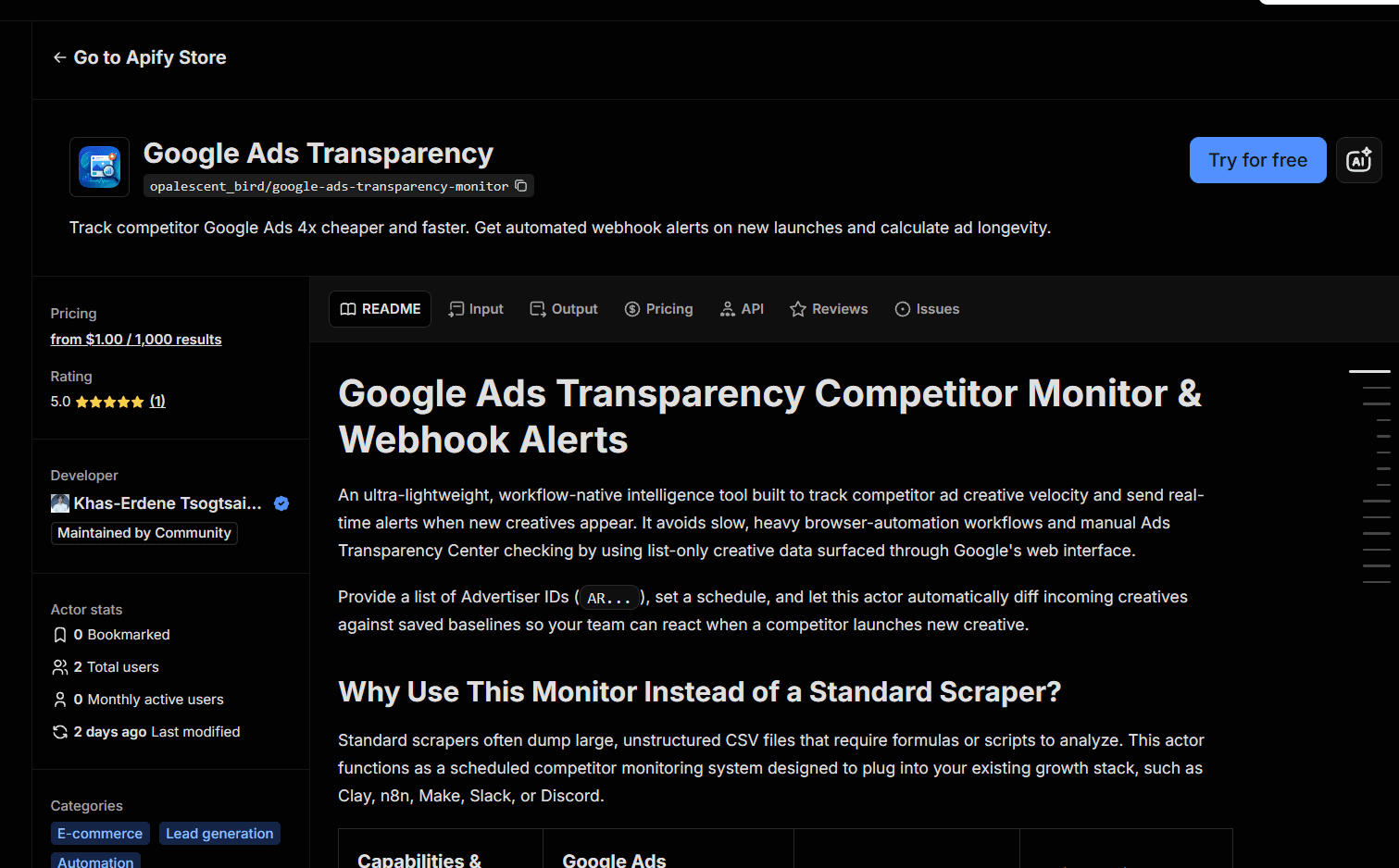
An Apify actor that packages Google Ads Transparency monitoring as a repeatable data extraction workflow, making it easier to collect structured ad data for analysis or LLM-assisted review.
Adds a lightweight proof point around scraping, automation, and data infrastructure outside the main product portfolio.
Small developer tools are useful when they turn messy public web data into repeatable, structured inputs that other systems can use.
The constraints, reliability decisions, and system boundaries behind the visible product.
Packaged a public-web monitoring workflow as an Apify actor so collection could run repeatedly instead of depending on manual browser research.
Focused on converting messy ad-transparency surfaces into structured dataset outputs that can be reviewed, analyzed, or passed into downstream LLM workflows.
Kept it intentionally low-scope: a utility data-infrastructure build that shows scraping and automation range without competing with the main product case studies.
Designed the actor as a composable data primitive: explicit inputs, scheduled runs, structured datasets, and webhook-friendly outputs make the collected signals usable by analytics, alerting, or downstream LLM classification systems.