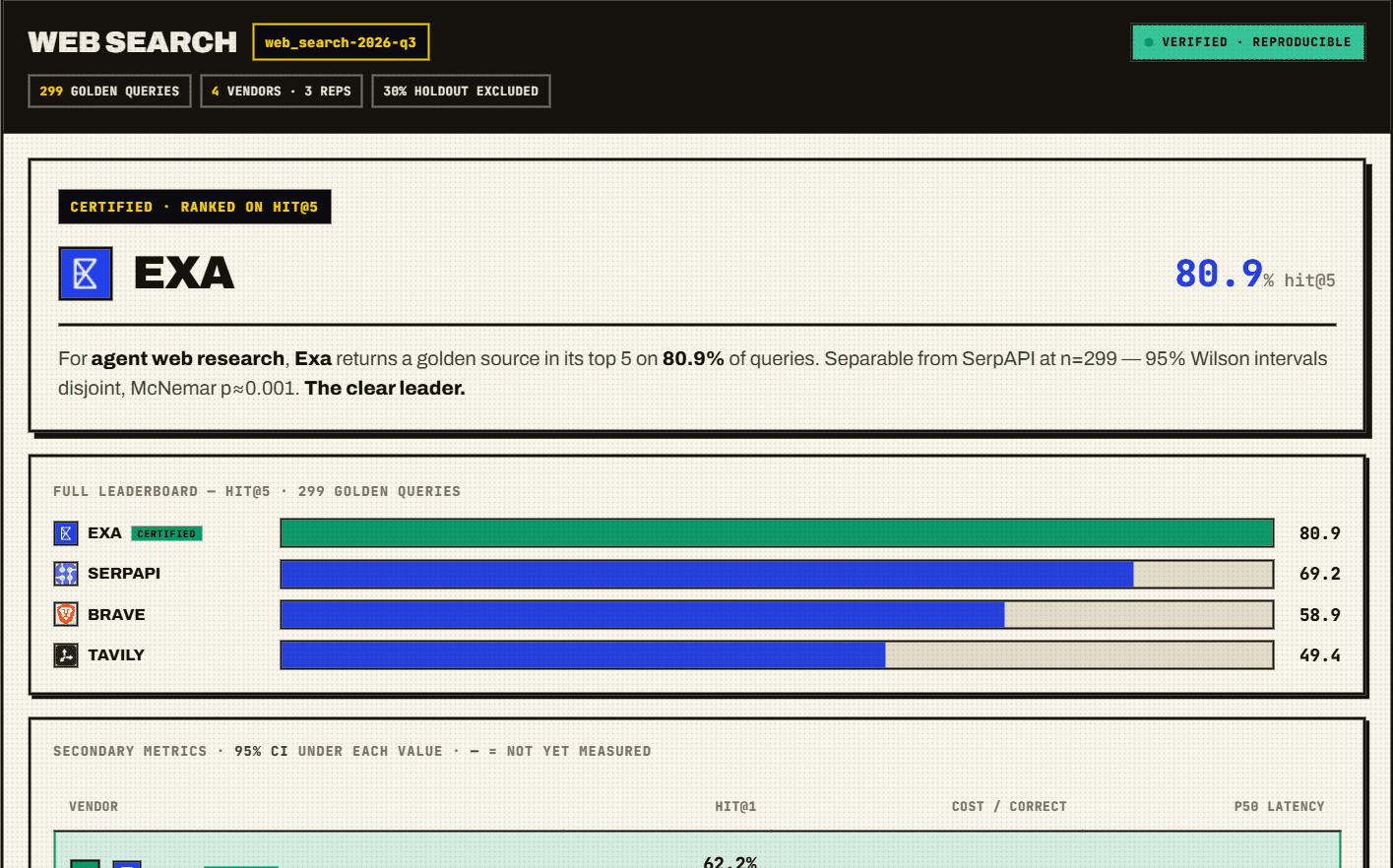
Modern AI products are assembled from infrastructure primitives, but teams still choose search APIs, extraction tools, rerankers, vector databases, and retrieval stacks through vendor demos, anecdotes, and one-off tests. PrimitiveBench exists because “one winner” is usually a lie: the best primitive depends on the slice, workflow, budget, latency, evidence requirement, and failure mode.
02 / What I built
The engineering response
A modular benchmark harness shaped as dataset → task → adapter → scorer → result schema, with frozen run contracts, deterministic seeding, public dev splits, private held-out answers, per-primitive eval packages, confidence intervals, statistical separability checks, and an MCP surface agents can query for slice-specific primitive recommendations.
03 / Impact
The signal
Reached 100+ GitHub stars, built a public trust anchor for vendor-neutral AI primitive evaluation, converted early paid evaluation-report customers, and positioned PrimitiveBench as a benchmark partner for CalCompute and public-sector AI infrastructure decisions.
04 / What I learned
The durable insight
AI evaluation is not only a metrics problem; it is a trust problem. The benchmark has to be reproducible, statistically honest, resistant to contamination, neutral to vendors, and useful enough for buyers to make real infrastructure decisions.
Engineering depth
How I engineered it
The constraints, reliability decisions, and system boundaries behind the visible product.
01
Structured the harness around dataset → task → adapter → scorer → result schema so data, vendor integrations, metrics, and reporting stay isolated and reproducible.
02
Designed for statistical honesty: per-slice scoring, Wilson/bootstrap confidence intervals, McNemar-style separability checks, and tie bands instead of fake global winners.
03
Separated public dev splits from private held-out golden answers with contamination controls, canary markers, and versioned methodology so the benchmark could act as a public trust anchor.
04
Extended the product thesis beyond a website by exposing slice-level benchmark results through an MCP server, letting AI agents query which primitive fits a constrained workflow.
05
Treated benchmark releases like software releases: versioned datasets, repeatable run manifests, provider-specific adapters, captured latency and cost telemetry, and CI-compatible artifacts make regressions auditable instead of anecdotal.